
I’ve had a BCM barrel for years. There has been nothing wrong with it and it has proven to be very resistant to the elements. The only real complaint I’ve had about it is in the accuracy department. It has been fed a variety of ammo, but it never managed to group better than about 2.5-3 MOA. Now, that level of accuracy is acceptable for most carbine applications, considering military specifications allow the M4 to be up to 4 MOA. However, when paying the premium for a brand like BCM acceptable accuracy is frankly unacceptable.
My cursory search about BCM accuracy issues brought up a surprising number of results. Many have reported the same issues. Some simply chalked it up to, “You’re paying for reliability, not a match rifle.” I found it hard to believe that an Anderson barrel grouped better than one from BCM.
Years ago, I heard an old guy say that all barrels are different and some rifles prefer certain rounds. These preferences could even manifest themselves from the same batch of barrels on the same assembly line. At the time, I thought that was more of a fudd-ism and a convenient excuse to make up for a lack of fundamentals. Then here I was, shooting a rifle that would routinely group 3-4” at 100 yards and I knew I wasn’t that bad. I decided to exhaust all options and listen to his advice before giving up on this upper. I’m glad I did.
Twelve different rounds were tested. They varied between different brands, quality, bullet weights and construction. As you can imagine, this was a somewhat costly endeavor given the current state of affairs. This “testing” consisted of shooting 5 shot groups of each at 50 yards. The barrel was also allowed to cool as necessary, which wasn’t hard given its profile and the fact it was 27°F outside. The barrel never even became warm to the touch.
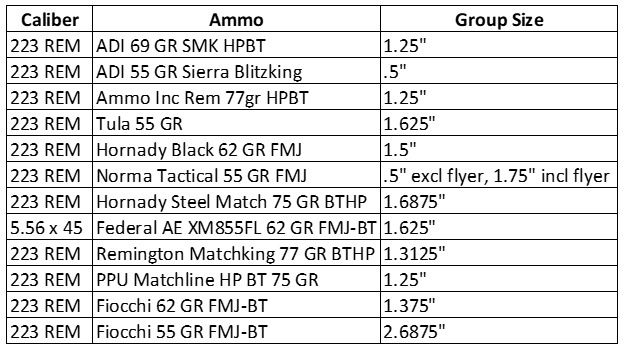
Why only 50 yards? I was limited by the magnification constraints of a 1-6x LPVO. It’s routinely used at 300 without issue, but the goal here was to test accuracy. Being able to see the grid lines simply provides a better aiming reference, which translates to more consistent results. Just double the group sizes and that will tell you the results for 100.
Why only 5 rounds? While a single 5 round group does not provide a statistical significance to demonstrate accuracy, it’s really a moot point. This test was to see which ammo my rifle liked. I have enough faith in my fundamentals and the ammo quality for this small sample size. Seeing a giant list of tabular data is nice and science-y, but it won’t necessarily confirm anything to you about your combination of ammo, rifle, and environment. Like ballistic calculators, they may be close or dead-on, but ultimately you have to confirm for yourself.

10 out of 12 of these groups reinforce my previous findings at around 2.5-3 MOA, which would explain my frustration about the accuracy issues with most ammo. From an outsider’s perspective, it may appear that these group sizes are from shooter error, as evident by the vertical stringing in 3 to 4 of the groups which normally suggests poor breathing technique. Rest assured; each group was done at a snail’s pace with every shot taken during the natural respiratory pause on the exhale.
There are two outlier groups, which should put concerns of poor fundamentals to rest. For some reason, this barrel likes the lighter rounds like ADI’s Match 55 GR Sierra Blitzking and Norma 55 GR FMJ. The ADI rounds grouped an impressive ½ inch, which translates to the coveted 1 MOA at 100 yards. I will take 1 MOA all day from a service rifle. Norma also seemed to group very well at ½ inch if you exclude the one flyer, which was possibly caused by a mixture of shooter error and the fact it was truly a cold bore shot. Does this mean the rifle will always group this well with this ammo? Maybe, maybe not. But the fact that it was able to do it twice with two different types of ammo is a great start.

Shown here is the author’s best group. ADI’s packaging is very unique. 
Pictured here is the author’s rifle used for the test.
It appears this BCM barrel was able to redeem itself. While it seems to be picky with its ammo, thankfully it delivers impressive results with a common round like Norma. More 55 GR rounds will definitely be chosen for future testing. This brings up some interesting observations, though.
Nothing about this test reinforces the typical folklore propagated by forum commandos. This barrel has a 1/7 twist rate. According to the internet, it should prefer heavier rounds. Based on this, the opposite seems to be true. This barrel is chrome lined, which allegedly doesn’t lend itself toward stellar accuracy. It’s also BCM, which isn’t known for accuracy either. While it isn’t sub-MOA, for a non-match rifle 1 MOA is more than respectable, especially when combined with great reliability.
Trust but verify. The internet sometimes contains decent guidelines, but they should always be confirmed. When talking about real standards of accuracy, there are simply too many variables to make generalities between rifles and ammo. PRS shooters and snipers know this better than anyone else, collecting lots of information in their DOPE books.
Many would argue this obsession with accuracy from a carbine is unfounded. AR-15’s aren’t meant to be precision rifles anyway, especially with the increasing popularity of shorter barrels on pistols and SBR’s. They can still attain a high degree of accuracy with the right combination, however. While they are limited in range due to ballistics concerns, rifles like the MK12/SPR/RECCE have proven to be very effective in urban environments where the engagements aren’t just CQB distances. Many times, intermediate distances present themselves in these settings and a little more magnification and accuracy goes a long way. Sometimes it even helps for closer distances like 150m and in, where a target may be partially obscured behind cover. 150m shots can be taken all day with a red dot or iron sights, but that’s on targets that are fully exposed to you. Knowing how dangerous CQB is and the fact most don’t possess the skill to provide accurate fire at range, I also like having the option of increasing the distance if I was ever placed in a terrible situation like that.
Red Dawn scenarios aside, what are the main takeaways from this? Recommendations are just that, not dogma. Go test different loads. Every rifle is different. It’s up to you to figure out what yours likes.

 Pro-Gun Millennial
Soi have found, both with semi autos and bolts that they like what they like for ammo, and spending the time and money to try different ammo is always worthwhile when hunting for accuracy. I was shocked to find my stock Savage 110 in 30-06 loved Remington core-locts in 180 grains more than any other ammo(including ammo 3 times more expensive).
LikeLiked by 2 people
It truly is fascinating. I can understand why some get frustrated quickly, though. I guess the best advice I can give is trying a variety of bullet weights, construction, and manufacturers so that one hopefully sees a trend in what the gun likes, even if they don’t find the golden round that day.
LikeLike