
Revolvers are a contentious subject. It used to be that if you were serious about personal protection, you only carried a wheel gun. That time period died out about 40 years ago. Today carrying a wheelgun might get you asked if you even take personal protection seriously.
Some people say that they are great for beginners, women and old people. Most will say that they are actually terrible for beginners, women and old people.
Who’s right? Well, let’s look at it objectively.
*This post will deal almost exclusively for defensive revolver usage. For recreation, do what makes you happy.*
What’s Bad About Revolvers?
Basically everything. At least, that’s what it looks like the more you start to learn about guns. You see, just about everything the modern gun community uses to determine the usefulness of a gun is a revolver’s weak point.
Triggers
Triggers on a revolver are something that even the newest of new shooters can pick up on. Long & heavy are the two words that always describe a revolver’s double action trigger when compared to any single-action or striker fired gun made today. With trigger pull lengths between half and a full inch of travel, and weights measuring under 9 lbs in a good example, the revolver’s double-action trigger isn’t easy to overcome. While that is also true of DA/SA autoloaders, at least when they cycle the slide it’s single-action from there on out. With a revolver its double-action every round unless you stop to cock the hammer. Shrouded and bobbed hammers render the gun a double-action-only, something I’m not a fan of.
If you don’t have a strong trigger finger before you start practicing with a wheel gun, you’ll have one soon enough.
Reliability
Once again, not where you want to be dropping points. Glock and every other gun who has copied and/or surpassed it use durability as a selling point. Revolvers aren’t known for their ability to handle abuse like an autoloader, and for good reason. With a modern polymer framed striker fired gun, you could run a 1,000-round-a-day class for literally days on end, lubing here & there as needed. A revolver would never survive.
I was listening to a Primary & Secondary podcast a few months ago when one of the panelists mentioned how back when police still issued wheel guns, during their training they’d stop and clean the guns every 60 rounds. Every person would stop, every gun would get cleaned, every sixty rounds. I doubt that it was entirely necessary to stop and clean that often, even if it was just debris from under the extractor, but the fact that it was policy means that those guns had a reputation of fragility. A reputation that modern guns do not have.
Capacity
Probably the biggest, most obvious, and most legitimate critique of a wheel gun. With few exceptions, revolvers carry six rounds. The most popular revolvers on the market are J-frame Smith & Wessons and Ruger LCRs. Those are notable because they only carry five rounds, a staggering 15% drop in bad-guy-stoppers. There are a few configurations here & there that carry more than six rounds, but they number less than a half-dozen that I’m aware of, and they top out at eight. Not exactly “high-capacity” by anyone’s standards (besides New York).

A Glock 17 holds 17+1 rounds in the gun. With a simple magazine swap, you have another 17 ready to go. With a functionally single action trigger, moderately skilled individuals can lay down absolutely withering fire for a long period of time just by themselves, given enough mags.
Revolver reloads? Six rounds, 4-6 second reload, six more rounds, 4-6 second reload, six more rounds. That’s what the Glock had in it from the start. Need I say more?
What’s Good About Revolvers?
The more you learn about guns, the worse they look. Then you start to learn a little more and you start to realize that they have some upsides hidden among their downfalls. These are some of them.
Triggers
Double action triggers on revolvers are long and heavy, yes, but they aren’t bad. On anything but a J-frame or LCR or similar low-budget wheelgun, the double action will be smooth and consistent. As far as I’m concerned, consistency and lack of grit are what make a trigger good. Short travel and low weight only make it easier to mask or ignore grittiness. If the trigger breaks at the same point every time you pull it, your brain will learn where that point is and you can shoot the trigger well with practice. It will require more time than a single action or striker trigger, but it is very doable.
If your definition of a good trigger must include weight and length, then a revolver’s single action trigger will definitely qualify as good. In fact, a half-decent revolver trigger will very likely be better than any other trigger from anything besides a nicer revolver’s trigger! Revolver single-action trigger pulls are short, light, and crisp. If that doesn’t count in your mind, you’re in denial.
Reliability
While revolvers are easily susceptible to abuse, they are far more tolerant of neglect. If take a revolver and a bottom feeder, load them both up, and toss them in a drawer to be forgotten about for a decade, the revolver is more likely to actually function. Since the semi-auto operates on energy harvested from the fired ammo, it is a timed balancing act of forces. Revolvers are completely operated by the hand strength of the user, a little more grit here or there, or a touch more friction than should be expected, won’t keep it from operating. If you plan to maintain and look after a gun that you run tens of thousands of rounds through, a semi-auto is your best bet, but just loading up and tossing in a drawer? Revolvers are the better option there.
Accuracy
This one is no contest. The revolver is as accurate as the ammo you put into it, just like any other fixed barrel weapon. A revolver’s barrel is permanently mounted to the frame. A revolver’s sights are machined into, if not just a part of, the frame as well. The relation between the sights and the barrel do not move at any point during firing. To say that revolvers are mechanically consistent from shot-to-shot is a massive understatement.
Compare the above to a standard Browning tilting barrel action. The barrel moves, tilts, and reengages with the slide. The slide moves forwards and backwards on the frame, while carrying the sights along with it. The slide’s position on the frame determine’s the barrel’s position on the frame, as well. There are a lot of things moving around, and all of those things need to go back to exactly where they were before the last shot was fired. Not to say that semi-autos cannot be accurate, but a gun that has the mechanical consistency required to compete alongside wheelguns are crazy expensive.
This benefit is really only over guns with rotating or tilting actions, but since those make up >95% of semi-auto handguns sold in the US every year, it applies to just about every gun that a revolver will be compared against.
Safety
This one might be the most contentious point I’m going to make, so I’m going to try to lay it out clearly: Revolvers are safer than striker-fired guns. While not an entirely unreasonable assertion, some people would claim that as heresy. Until recently, I was one of those people.

Let’s say my general chances of shooting myself with a striker fired gun are 1 in 3,000. Good odds, right? If I carry once or twice a week, that means I shouldn’t have to worry about an ND into my leg but once every 20-30 years. I can live with those odds, but that situation doesn’t describe me. I carry my gun all the time, maybe 340-350 days a year. If I should expect to accidentally shoot myself once every 3,000 carry days, that 20-30 years drops to 8-9. I’ve been carrying for 6 years already. Now, what if my odds weren’t 1 in 3,000, but 1 in 10,000? It would be inconsequential to the dude who rarely carries, but not to me.
I’m not saying that I’m getting or being negligent, just that I am only human. I cannot be super vigilant all the time. I’m not going to act like I am so safe that I could carry every single day for a century and never have a negligent discharge, and anyone who thinks that is delusional. I do everything I can behaviorally to make myself as safe as possible. Why would I not consider adding something to mechanically catch myself if I happen to screw up one day? Especially if I am willing to train around the downsides that it brings.
Who Are Revolvers For?
The pros & cons of a revolver suggest that it is either a gun for total novices who know absolutely nothing about guns and will never learn, or for experts of handgunnery who can fully leverage the advantages of the platform and have the skill necessary to mitigate or overcome the downsides. I believe that both of those positions are true.
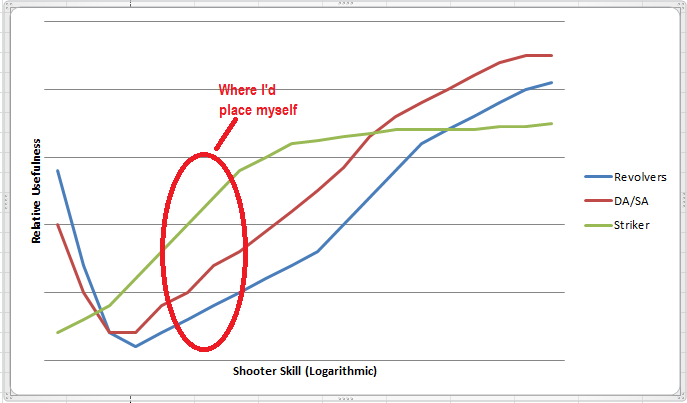
For Total Newbs (Far-Left of Graph)
A revolver is useful for someone who feels like they want a gun to toss in a drawer and won’t think about it until they hear a bump in the night.
- The recoil of a wheelgun is harder to deal with than with a comparable semi-auto, but it cannot be limp-wristed. If recoil control is non-existent, then this might be a factor.
- This person doesn’t have the skill and habits necessary to be safe with a safety-less striker fired gun.
- This person would shoot a Glock/M&P/etc. so poorly that the ‘easier to master’ trigger of such a gun would be wasted.
- Low ammo capacity is not a benefit, so much as normally a moot-point. Most people don’t need more than a half-dozen rounds for a single defensive use. John Correia at Active Self Protection (you should watch his daily videos if you take self defense seriously) has watched well over 10,000 defensive encounters in the past decade. He has seen more people fighting for their lives than I will ever meet. Most gun uses he’s seen involve the defender emptying their gun at the attacker, no matter the size of the gun.
- He’s also never seen a single instance of a non-cop reloading mid-fight, even from revolvers and micro pistols.
For Experts (Far-Right of Graph)
I also believe that revolvers make excellent tools for those skilled enough to mitigate the mechanical downsides and leverage the advantages of them
- This person carries and is around guns enough that the double-action trigger provides a useful increase of safety.
- A smooth double action would be of little detriment to someone who trains on it.
- The fixed barrel and single-action trigger make for a superbly accurate gun for those who practice with it (in the unlikely event that they needed such precision)
For Beginners & Intermediates (Entire Middle of Graph)
Revolvers are a bad idea. Now, I know what you’re thinking, “If they are good for total newcomers and high level experts, why are they not good for everyone?” Well, because… it’s weird.
- The danger of a striker fired trigger is largely overcome by the vast majority of people who even halfway take pistol safety seriously. “Finger off the trigger” pretty much sums up everything you need to know about being safe with modern pistols. It’s four words, it’s not hard. Once you get the habit of keeping your trigger finger off the trigger, the double action trigger loses the majority of its inherent safety. DA only becomes a viable safety measure again once you’re so involved that random freak occurrences might eventually happen to you. That’s not a level that most gun owners are on.
- The double action trigger, while definitely learnable, is harder to master than a striker-fired trigger. Legions of gun enthusiasts out there claim that Glock triggers are better than double action triggers. They are wrong, but not by much. A simple, relatively light single-action (or striker, not much difference) pull is always going to be easier and faster to master than a long, heavy double-action, no matter how smooth.
- The increased accuracy of a fixed barrel will be wasted on all but the top 2-3% of enthusiasts. Not owners, but people who actually care about being skilled, or read gun blogs online. While a fixed barrel will always be more mechanically accurate, a modern semi-auto is more accurate than 97-98% of the people who actually practice with them. The prevalence of after market barrels for those guns these days bumps that number up significantly. Some people will need a very accurate gun, but those people are few & far between.
- Most enthusiasts and serious defensive-minded shooters use their guns enough that the reliability could become an issue. The abuse they’d put on a wheelgun would get expensive if they tried to shoot them to the same volume a lot of people put through striker fired guns. There aren’t a lot of revolversmiths out there any more, and a Glock can be detail stripped with a ball point pen. The cost/benefit favors the bottom feeders.
- Wheel guns usually hold half a dozen rounds, and reloads take forever. If you ever face more than one or two dudes in a defensive situation, a revolver may not hold enough rounds to see you through it. Statistics indicate that this is a very unlikely occurrence, but people do get struck by lightning.

Niche Guns
Caleb Giddings describes it as a U-shape of usefulness. Very useful at the two extremes, and inadvisable anywhere near the middle. I like to call is a well curve, because I saw a Far Side comic one time where a researcher had plotted his data upside down. This is kind of the same way I feel
Revolvers are ideal for very few people. They are just an old design. Samuel Colt’s Single-Action Army was formally adopted almost 200 years ago, and the final modification into what we’d call a modern revolver taking place almost 100 years ago, they are just old designs. They have big downsides that we’ve spent the last 2 centuries improving upon, and yet they also have advantages that we have trouble replicating elsewhere even today. They are most suited for niches in the extremes of handgunnery, and not just in skill level.
Handgun hunting, regardless of skill level, is a revolver game. Some companies have introduced long barreled 10mm pistols and call them ‘hunter’ models, but they’re on the bottom end of what hunting revolvers can do. The Coonan 1911 comes chambered in .357 magnum and is considered to be a formidable, very powerful pistol. It’s also the weakest ‘magnum’ cartridge that most companies chamber revolvers in. The most powerful production handgun rounds on the market are the .500 S&W Mag and the .460 S&W Mag, both revolver rounds.
Conclusion
Revolvers are interesting. They are outclassed for most people in the majority of roles, but in very specialized roles or skill levels, they actually begin to shine. They dominate both the super small end of EDC handguns as well as the top end of hunting. They are for both the very skilled and the completely inexperienced.
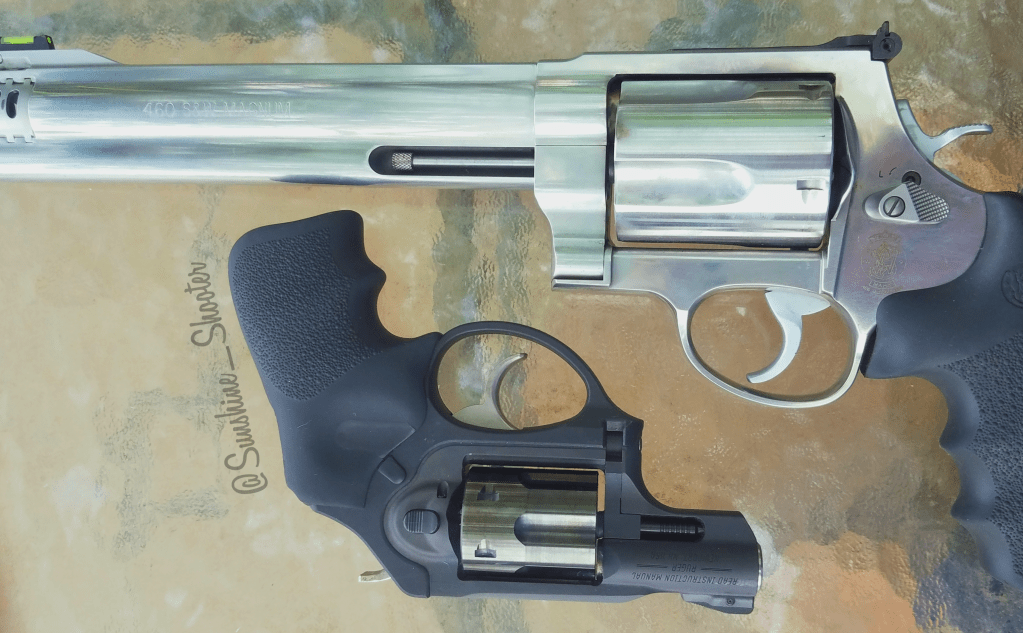
Everyone should own a revolver. The two in the cover image are mine. I use the black one for lo-pro carry when I want to go a little more discrete that my normal gun will allow. Practicing with the double-action trigger actually makes me a better shooter of my main striker fired carry gun, too. The giant, stainless monster in the is purely a range toy. It has legitimate uses in hunting and distance handgun shooting, but I mainly use it for fun. I’m sure everyone reading this has space in the safe for at least one. Besides, it’s fun from time to time to switch it up. Those bottom feeders get boring after a while 🙂
If wheelguns are your thing, or if you think they might be interesting to you, check out Revolverguy.com.
Stay objective. I’ll see you next Friday. -S_S
 Pro-Gun Millennial
The reasons you gave for liking the revolver are the same ones I use for justifying a DA/SA pistol as my EDC. I’m assuming by safety you’re referring to a lower probability of an ND.
It’s also the reason I more or less insist on a thumb safety for my striker pistols.
LikeLiked by 1 person
Yeah, that’s the majority of it. The more I think about it, the more I wonder why we’re fine with SAO pistols llike 1911s needing a thumb safety, but not striker-fired handguns. I really like my M&P, but I think I need to move on.
LikeLike
Hehe, it’s exactly that scenario of SAO hammer guns with safeties that makes me roll my eyes. This goes back to my own article on Glock Hype. At some point, people took Glock’s marketing materials too seriously. As long as you actually train to use it, a thumb safety is perfectly usable on a pistol.
LikeLiked by 1 person
I love the M&P Series, too. I wish the Shield (or the new 4″ PC Shield at least) came with the same thumb safety that’s on the double stack models – I’d use it. As you know I carry a 1911 and the M&P’s thumb safety is a pretty close replica of the 1911.
LikeLiked by 1 person
Awesome post! I confess I often carry my LCR or S&W 642 when I’m about the house or desire more discreet concealment or even the occasional times that I carry a second gun.
LikeLiked by 1 person
Thanks for the kind words! There’s nothing wrong with carrying a little wheel gun here & there, that’s one of the places where they are most useful.
LikeLike
Hey man, thanks for the revolver love and the shout-out! Great post, and great exploration of the goods, the bads,and the uglies of revolvers!
LikeLiked by 1 person
Thanks for reading! Any online discussion of wheelguns that doesn’t even mention RevolverGuy is just wrong.
LikeLike
Old post but worth applauding. I’m in my 50s, and I’ve been a revolver shooter since I was in my teens. I prefer the feel and the range of options, the lack of ejected brass, and the fact that like so many cops used to do over the years, I can clean my stainless 357 in the dishwasher if I want to. Simplicity has value.
LikeLike