
For the sake of transparency, the purpose of this blog is to inform people of the Second Amendment who are unfamiliar with or even vehemently against the principles of it. I hope in doing so that I will at least let them entertain the possibility of reconsidering their viewpoints.
If you’re a person who is steadfast in your beliefs and don’t want to hear ideas from another side, then by all means stop reading. However, if you aren’t opposed to keeping an open mind, then please stick around. I would like to provide a practical perspective on something that is so politically charged that most can’t have civil discussions about it.
Before diving down into the details, I will tell you I won’t be exclusively spouting off tons of statistics on crime and relying only on data charts. Why is this? Numbers can be skewed, sliced, and diced to fit any agenda. You can take the exact same set of data and have it tell you two completely different stories, depending on who is analyzing it. Many associate lots of boring numbers with credibility and gloss over them, looking for the nuggets in whatever they’re reading to validate their viewpoint. Major news media outlets have recognized and reinforced this, unfortunately. So while I’ll reference some straightforward data to demonstrate points, my focus is to relate with readers more than lecture them.
Additionally, when showing many people data, they’ll often wonder how it was collected more than the data itself. The irony is that most are too lazy to examine data to determine its validity, so they’ll continue to hold their beliefs regardless of what you show them. It’s a cop-out. “There is no way those statistics are correct, but I don’t have the time go look at them.” I’m picking on both Republicans and Democrats here by the way. It’s a natural human tendency.
This is a major problem when both sides try to convince the other. They bombard each other with numbers that they don’t care enough about to research or argue abstract principles that only serve to reinforce their ideals versus trying to convert others. I don’t mean this in a condescending way. It’s just a realistic perspective. Conservatives and Libertarians who want to spread the good word about the Second Amendment are simply shouting in an echo chamber when they tell liberals why their perspectives are false, based on the Lockean concepts of which our constitution was formed. While it isn’t wrong, it’s hardly applicable to most individuals on a day-to-day basis now that we’ve become so far removed from our origins. Knowledge of philosophical concepts won’t solve our societal problems immediately, and this lack of a pragmatic perspective is where we always lose each other with political issues.
My goal is to remedy this by examining the Second Amendment at a level where it’s relatable to individuals and families, not just party perspectives. I’m going to do this by providing a realistic outlook on today’s issues and examining historical contexts from which we can learn. I hope you enjoy it.
The Human Condition
Regardless of your beliefs, self-preservation is an innate trait. It’s biologically programmed into our basal ganglia, or what some refer to as the reptilian part of our brains. It’s the most basic, primitive part of our existence so we can carry on and propagate the species. This trait exists in every animal on this planet. To deny this is naïve.
Unfortunately, that same part of our brain is also responsible for behaviors that tend to be more aggressive, which benefitted us back in a primitive world. This was necessary to obtain resources and reproductive partners.
Believe it or not, we really aren’t that far removed from this mindset. Sure, we’ve advanced from our primitive days, but we still fight over what are essentially the same things. We fight over significant others (mates). Countries (tribes) and individuals still fight each other over resources they need. This why crimes like robberies, burglaries, rapes, and murder still occur. It’s why war and genocide still exist.
There are only two ways to communicate in this world—reason and force. When reason fails force prevails. This will always be the case. Typically, once force is implemented by one side there is no amount of reasoning from the other side to make it stop. It ends with the weakest succumbing to the wills of strongest. This is an uncomfortable thought for many, myself included. However, in a world with aggressors this is an unavoidable fact.
This is usually where people—who I think generally have their hearts in right place—call for action by means of gun control to remedy this force issue in our modern world. It sounds great in theory. We know that a small percentage of people will always commit crime so we’ll just stop enabling them by taking the tools away, right? People cite examples such as the UK and Australia for this. There is a giant problem with this, though.
Even if you could make 99% of Americans get on board with this, there will always be a criminal element. And this fact remains, there are over 400 million firearms in America right now. There is no possible way you’re going to get them all. Even if you ban all imports of parts and accessories to dry up the remaining supply of arms, it won’t work. An ATF agent would have to be present at every machine shop and every house that has a consumer grade 3D-printer. New parts and firearms will always be manufactured. Europe is dealing with this fact right now by trying to censor CAD files.
Knowing this, criminal and terrorist elements will take advantage of the situation. It’s too easy not to. Home invasions and burglaries will skyrocket. If you don’t believe that, feel free to examine statistics from other westernized countries that have implemented strict gun control. “But statistically crime will go down overall.” That isn’t exactly true, but I will entertain the concept at face value to make a point. Even if the likelihood of you becoming victimized goes down, would you still be willing forego any real advantage you could have against an assailant? See, this is the difference between arguing in the abstract and dealing with potential consequences in a more concrete reality.
People will assume the perspective of needing a firearm for protection is a result of fear mongering or being paranoid and that it’s statistically unfounded. Statistically, they would be right. Your chances of being the victim of a violent crime are extremely low. It’s ironic, though, considering advocates for gun control cite violent crime as an epidemic and use it to fear monger at the individual level, so which is it?
Statistics don’t mean anything when you’re actually in a situation. No one is robotic or utilitarian enough to say, “Well, my family member or friend died because they didn’t have a means to defend themselves, but you know what? It’s not statistically relevant. There is greater good overall.”
While traveling through rough parts of town, I’ve had anti-gun friends ask me, “Hey, you’re carrying, right?” Self-preservation seems to be an instinct none of us can escape. When you’re in the real world, all that matters is what is happening right then and there. No amount of virtue signaling or moral superiority is going to stop someone from cracking open your skull amidst your utopian ideals.
Some suggest the act of compliance is enough to de-escalate situations. “Just give them what they want. They don’t want to kill you.” It’s hard to argue for or against this, as every situation is different. However, one thing is for certain—compliance isn’t always a guarantee for personal safety. Do most robberies end in murder? No. There is a logical fallacy in this presupposition, however. We are assuming criminals view the world through the same lens as us. To us, a wallet is not worth taking a human life. It’s illogical and our risk versus reward center tells us that in addition to being morally wrong, it’s also disproportionate to the potential legal risks involved.
Psychological and physical evaluations of violent offenders have revealed to us that the risk versus reward center is skewed in their brains. The very act of threatening you with force tells you they are less risk-averse than you. In effect, they are wired differently, and potentially less psychologically stable than you are. To attempt to reason on the same playing field with these people automatically puts you at a disadvantage. They are by definition unreasonable.
Let’s look at this from their more primitive perspective, though. Just because I ask you to give me what I want doesn’t mean I won’t kill you afterward. It wouldn’t make sense to shoot you, alert everyone around me, and then spend 30 seconds searching your body for your phone, jewelry, cash, or whatever valuables you have. It makes a lot more sense to keep things quiet, have everything neatly handed to me, and then shoot you if I feel like you’re going to run to the police. I have everything I need at that point and the bonus is I won’t have a witness. You see this often with car jackings. They hold someone at gunpoint, tell them to drive somewhere secluded, and then kill them there.
Is this an extreme perspective? Yes, and I think most people are offput by it, telling themselves that most criminals aren’t this extreme. I think it has to less to do with criminals being that extreme and more to do with the fact that people don’t want to think of criminals being that extreme. To address this is to address your own fragile mortality where you start to run grim scenarios in your head. It’s an uncomfortable realization that you’re vulnerable at any given point and ultimately are your own first responder.
The idea of fighting to most is uncomfortable. Most people want peace and don’t want to hurt anyone, but to exchange personal safety for supposed higher beliefs is essentially dumping the responsibility of your safety onto someone else. This is invariably manifested as the police. They can’t be everywhere at once, though. Even if they somehow managed to get average response times down to 5 minutes from 11 minutes that’s still a lot of time. Response time is much longer in rural areas too. If I were a bad person, I could slaughter an entire family and ransack their home of everything worth significant value in 5 minutes. If you don’t believe that, review security camera footage or helmet camera combat footage from various situations from around the world. In these scenarios, seconds are like minutes and minutes are like hours.
As a last-ditch effort to negate the idea that safety is a personal responsibility some will say, “Okay, so you have a gun. You think you’re Rambo and can do anything now?” This is usually followed by a plethora of what-if type of scenarios. Most gun owners realize having a firearm is not a magical talisman that will enable anyone to defeat all of the evil-doers in the world. However, having one sure beats not having one and being behind the curve from the start. Would you rather die having a chance to defend yourself and your family or would you rather die begging for your life?
Culture and History
Culture is a multi-faceted issue for the second amendment. Many don’t understand its origins or purpose. The Second Amendment has nothing to do with hunting. Back when the constitution was written, if you didn’t hunt, then you didn’t eat. Firearms were part of the subsistence agriculture and everyone had one because of this. There would have been absolutely no reason to address that within the constitution.
“A well regulated Militia, being necessary to the security of a free State, the right of the people to keep and bear Arms, shall not be infringed.”
Many will focus on the word regulated. “See! Even the founders agreed with common sense gun control measures.” This is incorrect. Language evolves over time and loses context. We take this into account when interpreting all sorts of historical texts and it would be disingenuous to not use this same logic on our constitution.
Within the context of the time, well-regulated referred to the militia being disciplined and trained. So, who is the militia? “A group of private citizens who train for military duty in order to be ready to defend their state or country in times of emergency. A militia is distinct from regular military forces, which are units of professional soldiers maintained both in war and peace by the federal government.” Ordinary citizens are the militia and it’s up to them to maintain sufficient standards as best they can. This is further reinforced by the second half of the sentence. “…the right of the people to keep and bear Arms, shall not be infringed.” Notice the specific wording. It says people, not military personnel.
To provide a little more context, you need to remember that the United States just finished fighting the Revolutionary War against the British. The reasons are many and complex, but at the root of them was a tyrannical government that bullied its people without adequate representation. Militias greatly aided the ragtag Continental Army when they could. In modern times, many would call them insurgents. You read that right. Our origins can be traced back to what many would now call terrorists fighting against a larger regime. Remember, one man’s terrorist is another man’s freedom fighter.
To those who say that the National Guard is the militia, that is historically inaccurate. Having been in the Guard, I heard many cite the same thing and the official website is even incorrect. The only reason they refer to themselves as the original militia is because it earns bragging rights to say you’re the oldest branch that helped establish our country. They are referring to the Massachusetts militia founded in 1636, which was essentially three ragtag regiments of men who trained part time and weren’t exactly professionals with tons of funding (basically the definition of a militia). They were also localized and didn’t have a purview of national defense.
The modern National Guard didn’t exist until 1916. The National Guard, as we know it today, is a state-based military force that is frequently activated federally. By definition that is not a militia. It was created as a supplement to the military to help stomp out Pancho Villa and presumably because WWI needed more bodies. To compare the National Guard to a militia is ludicrous, considering it has played substantial roles in WWI, WWII, and the GWOT (Global War on Terror) 6-7,000 miles away from our soil. That hardly sounds like the job description for a regular militia.
The founders figured out that keeping citizenry armed helped keep governments in check. It’s the reason they worded the Second Amendment in general terms rather than specifics; it was meant to hold true regardless of era. So, those who say, “The founders had muskets and never envisioned an AR-15. It’s an outdated document,” are actually wrong and are going against the intent of the document.
To maintain true liberty, governments cannot maintain a monopolization on force. This helps ensure representatives have to be civil servants and keep their constituents’ best interests at heart rather than becoming corrupt and self-serving monarchs and dictators. The farther away you get from this, the more government officials tend to self-serve and worry only about self-preservation; it’s hard to find a more relevant situation to that than today.
It’s no coincidence that the Second Amendment is only second on the Bill of Rights and covers firearms ownership specifically. It’s the second most important right other than free speech. Free speech is necessary to maintain a true democratic republic and any restriction thereof leads to totalitarian regimes, whether it be monarchical, fascist, or communistic in nature. To safeguard against this, the importance of the Second Amendment was recognized. It gives the constitution, and specifically your Bill of Rights, the teeth it needs to protect itself. It’s a self-preservation policy set forth to prevent tyrannical overreach. Within the context of the time, this makes complete sense, as the thirteen colonies were all too familiar with government abuse.
Some will argue the government already has a monopoly on force now, rendering this amendment useless. However, more modern conflicts like the Vietnam war and the GWOT contain many embarrassing examples of underequipped fighters prevailing over a highly developed force. Insurgencies aren’t effective because they go toe-to-toe technologically against a professional army. They’re effective because they garner support from the populace and make an ideal very hard to kill, turning what would be a standard war into a conflict that drags on for years or decades, while killing the morale of the larger opposing force. It makes an objective require too much effort to succeed.
To suggest an armed revolt against your government seems alien or extreme to most, but this is exactly what the Founding Fathers gave us the means to do. It maintains order through a balance of power. The thought of this may seem gut-wrenching to some and they may be willing to forego some of their rights to avoid unnecessary bloodshed. While morally admirable, a simple fact remains. Governments have killed more people than any other human construct in history. Their lethality is rivaled only by the natural world (disease, climates, etc.) and that might even be a toss-up, depending how you analyze it.
Unfortunately, the author for the next following statements can’t be verified, so credit can’t be given where it’s due. I’ve also taken the liberty to add some additional points. Here are some highlights from the 20th century pertaining to gun control:
In 1929, the Soviet Union established gun control. From 1929 to 1953, about 20 million dissidents, unable to defend themselves, were rounded up and exterminated. This doesn’t include WWII combat deaths or the almost 4 million that starved to death in Ukraine.
In 1911, Turkey established gun control. From 1915 to 1917, over 1 million Armenians, unable to defend themselves, were rounded up and exterminated.
Germany established gun control in 1938. From 1939 to 1945, roughly 6 million Jews died at the hands of the Gestapo and SS.
China established gun control in 1935. From 1959 to 1961, about 30 million, unable to defend themselves, were executed or starved to death.
Guatemala established gun control in 1964. From 1964 to 1981, 100,000 Mayan Indians, unable to defend themselves, were rounded up and exterminated.
Uganda established gun control in 1970. From 1971 to 1979, 300,000 people, unable to defend themselves, were rounded up and exterminated. The total dead are hard to estimate with the country’s constant genocides, wars, and lack of reporting but it’s guaranteed to be in the millions.
Cambodia established gun control in 1956. From 1975 to 1977, 1.5-3 million educated people, unable to defend themselves, were rounded up and exterminated. Roughly 1/4 of the country’s population was executed or starved. An infamous tree still stands as tribute at one of the many killing fields, which has an indentation on its side from the amount of babies’ heads smashed against it.
Unknown, as well as me adding verified dates/figures
Pseudointellectuals may jest they’ve debunked the statements above after finding their answers on the first page of Google, citing clearly unbiased and trustworthy websites like Snopes. However, I implore them to do real research and challenge these claims; it’s why I’ve included links for everything.
Some would suggest these implications are misleading. These democides weren’t caused by gun control itself. These tragedies were caused by varying combinations of government corruption, political instability, and bureaucratic inefficiency. While this might be true, it doesn’t matter what the exact mechanism was. The reality is, these people didn’t possess a means to defend themselves, and as a result they were extorted and slaughtered.
In the face of these facts, there is a tendency to compare the US against our modern counterparts in Europe. “They have gun control and they aren’t being slaughtered. Plus, all of those things happened back then. Times are different now.” Regardless of what people from other developed countries say, they are not as free as us. There is no other place on this planet that values individual liberty as much as the United States. Canada, our highly developed and most comparable neighbor, has compelled speech laws, for example. Just because a society has amenities does not mean it is free. The grass isn’t always greener on the other side. Europe has tons of social and violence issues that go unreported here because we largely don’t care but that’s another topic altogether. Regarding people being different, we are human beings. We have not changed much, if at all. History will continue to repeat itself.
Even after understanding the historical significance of the Second Amendment, many will still say that it is an outdated concept that needs to be revised under the guise of public safety. After all, violence in inner cities like Chicago and Baltimore is a big problem. In fact, it’s the worst in the nation. The fascinating aspect about cities like these is they have the strictest gun control laws. Why do they have the worst crime then?
Before anyone mentions St. Louis is awful too with laxed gun laws, that’s because their police departments were defunded and can’t keep officers thanks to “activists” post Ferguson, MO. This is an entirely separate issue. Cities have their own unique nuances that affect crime like economic opportunity or culture and cannot exclusively be explained by laws alone. However, we can start to make some observations with the below maps.

Sure, there are southern and midwestern cities thrown into the mix here, but notice how there’s hardly anything west of Missouri, until you hit California again, of course. Now check out the next map.
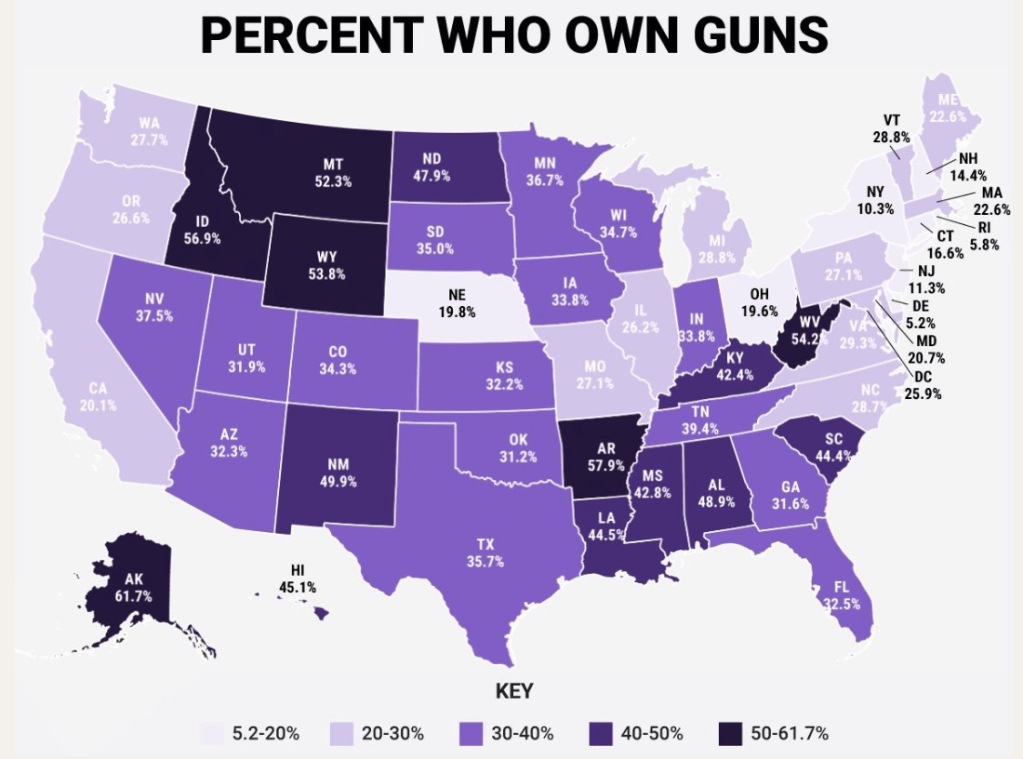
There appears to be a correlation between higher rates of gun ownership and less stringent laws with less murder. There are a couple of exceptions like Kentucky and Indiana, but that seems regional with clusters around that area in general. We can get into the weeds to find a couple more states that contradict this theme, but there is a glaringly obvious observation here. Most of the murders are in areas that either have low rates of gun ownership and or stricter laws.
Worth mentioning, this data is based on murder rates per 100,000 people to make this comparison fair. If the narrative we’re constantly being fed on gun violence was true, we would see the exact opposite on these two maps. “People are bringing guns in from other states, that’s why gun control doesn’t work. We need to have the same laws in all states to make this work.” Okay, that makes sense on the surface, but why aren’t all the areas where people are bringing in these guns experiencing the same levels of crime? By this logic, the more guns that are accessible, the higher the murder rate will be, but this simply isn’t the case.
Now, I’m not simple-minded enough to start the cliché argument that more guns equal less crime. I don’t disagree with the sentiment since it’s sort of backed by the above data, but you start to lose the other side when you say things like that. People start envisioning dramatic things like kids walking to schools with Uzis. The real question needs to be asked. Why do areas with lax gun laws or higher rates of gun ownership have less murders than ones with stricter laws? The answer is twofold.
First, the states with stricter gun control laws merely disarm the law-abiding citizens. The people who are good and follow the law will comply. This creates a power vacuum in the natural order of society. Who better than to carpe diem than the criminal elements? “You mean, I can burglarize, extort, rape, and murder without fear of lethal consequence? Sign me up.” This power vacuum incentivizes the less privileged in society to engage in this behavior because it’s easier than becoming a rags-to-riches story. It’s easy to deal drugs and steal things from people you know won’t fight back. It’s harder to work at a legitimate job and not steal things because you know one burglary may be your last. An armed society is a polite society because of this.
Second, there is a significant difference in culture between major cities and smaller towns in America. This is an unpopular opinion but the degradation of the nuclear family unit has led to the destabilization of culture. Recidivists are significantly more likely to come from single-parent households and this makes sense from a practical standpoint. If the parent isn’t around to monitor their children because they have to work, what are kids going to do when left to their own devices? Right, they’ll get into trouble and make awful decisions.
The high cost of living in these major cities also puts pressure these single-parent households, which creates poverty, increasing the likelihood of turning to crime to make ends meet. It’s a vicious sociocultural phenomenon. We aren’t experiencing a gun problem, it’s a cultural problem stemming from a myriad of issues. Getting rid of guns is simply treating the symptom instead of the disease.
At one time, people could possess short barreled rifles, sawed-off shotguns, and silencers without any special process. This changed when, in 1934, the NFA (National Firearms Act) was passed to curb gangster violence stemming from the Roaring Twenties with congress citing examples like the St. Valentine’s Day Massacre. It required a $200 tax stamp to legally possess any of these types of weapons, a prohibitively expensive barrier to entry that would be about $4,500 today. This made ownership of them almost impossible for anyone at the height of the Great Depression. Crime dropped significantly during this time, making gun control proponents cite its effectiveness. There is just a slight problem with this claim. Prohibition ended six months before the NFA in 1933. Firearms laws weren’t responsible for the decline in crime, ending a giant black market was.
Still, until the Gun Control Act of 1968 people could mail order Thompson submachine guns, anti-tank rifles, and other weapons to their homes from catalogs. Even after mailing firearms directly to your home was made illegal, machine guns could still be purchased easily as long as it was through a dealer. This fact wasn’t being sensationalized by media outlets of the time compared to now because, other than a couple of high-profile cases, it wasn’t a societal issue for the most part.
Case in point, in many rural areas until the 80’s it was normal for kids to have firearms in their cars at high schools. They had them for shooting sports or to hunt with after school. There weren’t mass shootings or surges in violent crime. You can’t say it was because the firearms were less lethal either. At close range, a simple 12-gauge shotgun is the most devastating weapon and will remove chunks of you (Germany protested it’s use in WWI for its brutality). Additionally, fully automatic AKM and AR-15 variants were available for purchase until the Firearm Owners’ Protection Act in 1986. People legally owned machine gun versions of the semi-automatic weapons that are being demonized today.
When and why did things change recently then? Circling back to the concept of the degrading nuclear family, gang violence started to soar in the 70’s through the 90’s in inner cities because of it. Numerous social issues and the war on drugs were also contributors that warrant their own discussion in greater detail.
To find a scapegoat, politicians opted for an assault weapon ban in the mid 90’s to counter the violence. It did absolutely nothing to prevent crimes because rifles (especially assault weapons) are used just a tiny fraction of the time. Handguns by far are the most used in crimes. It did nothing to solve the cultural problem and violence continued in inner cities until stricter policing and better technology started to put a dent in gang activities. And by the way, this gang violence was still never an issue for many southern and midwestern states like it was for their Northeastern and West Coast counterparts. Again, it all comes down to culture.

As you can see above, gun murders were already on a downward trend before the Assault Weapons Ban of 1994. Congress took advantage of a pre-existing environment to “show” its effectiveness. Some could argue there was a small spike right after the bill sunset in 2004. That’s a hard case to argue, considering the years that followed looked identical to the years during the ban.
2016 forward shows an obvious surge from a myriad of social issues. People weren’t just shooting each other, they were burning down cities and looting at a scale the country has never seen, making the LA Riots look normal. Some say we’re at a tumultuous point in our society that rivals or exceeds the 1960’s. This isn’t about taking any particular side, it’s about pointing out you would have to be blind to not recognize the instability. The cherry on top has been COVID and the heavy-handed response resulting in the destabilization of social order and the economy.
As a side note, the suicide rate is worth mentioning since regulation doesn’t appear to have an effect. Some may say, “People don’t commit suicide with assault weapons. It’s usually with a handgun.” This is an interesting observation because it’s factually correct. Rifles account for 3% of total gun deaths, according to Pew Research (link in the graph above). That figure includes all rifles in general, so the dreaded AR-15 is most likely responsible for even less. So, why focus on assault weapons when they aren’t responsible for the majority of issues? Because to be able to ban pistols, you need to ban rifles first. If you get rid of the rifles, it’s a lot easier to ban all guns because citizens cannot resist as effectively. Just ask Canada’s Trudeau about how he banned assault weapons and followed it up with banning handguns 2-3 years later. It all started with, “No one is coming to take your guns.”
There isn’t an easy solution for solving cultural problems, but I can tell you that taking away firearms isn’t even a temporary measure to address it. Even if you had a magic wand that disintegrated all guns on the planet, other methodologies will be used. Ask London, who is now banning knives. Ask Paris, who has experienced an immense surge in crime, to include beheadings in the recent decade. Ask Mexico who has some of the strictest gun control measures in the world. The theme here is that other underlying factors are causing crime, not guns in and of themselves. Violence is always a symptom, not the reason, for something. Our “something” is the erosion of culture and destruction of the family unit masquerading as progressivism.
Instilling cultural norms and values isn’t popular in today’s society. We can’t neglect our beloved Nietzsche and the morally bankrupt philosophy that is cultural relativism. To suggest responsibility, accountability, and a family other than the state could be offensive to some. However, this is the only way you’re going to even begin to come close to the concept of a utopia. People need guidelines and direction, not from the state but from people that harbor holistic values.
The Consequences of Insurgency
Before I proceed further, I will say that I do not condone violence or the idea of insurrection. I believe diplomacy needs to be completely exhausted first to preserve human life. Even outside the moral issues involved with it, it’s incredibly difficult and time-consuming to rebuild a country after something like that so it’s not a preferred method to enact change. With this understanding, please know the following paragraphs aren’t an idealization of civil war. However, I believe them to be a realistic outcome if certain policies were to be implemented in this country.
Even after reading everything up to this point, let’s say you’re still unconvinced and think that firearms need to be heavily regulated or cease to exist. If you’re talking about another assault weapons ban, gun buyback or even confiscation, there would be some significant barriers facing you to say the least. The most probable of these would be a mass exodus of enforcers. Conspiracy theorists say that when pensions and pay are threatened that the enforcers (LE/MIL) will do anything their masters say. I disagree for a few reasons.
Firearms culture has become so strong within the ranks of law enforcement and military in the last 20 years due to a complete distrust of the government. Who better to justifiably feel this way than government employees themselves? After all, it’s not like history has revealed it has lied to us repeatedly like the Gulf of Tonkin incident to get us into Vietnam or the WMD’s to get us into Iraq. Many would disobey orders or defect. No one wants to rat out family or go door to door confiscating their neighbors’ weapons. Plus, it’s a suicide mission. This is where gun control measures would probably end.
However, let’s assume that you could convince every law enforcement agency that confiscation was a great idea. Even with the most funded and well-supplied law enforcement units in the world, enforcing a confiscation would be problematic. The reasoning is quite simple. There are only 800,000 law enforcement officers in the United States. I can’t speak directly for law enforcement, but I know the vast majority aren’t trained for SWAT operations, which are skills that would be pivotal in accomplishing a mission like this. Even if 1% of the populace resisted turning their weapons in, that’s over 3.3 million people that will need to have their firearms taken by force. Anyone who has seen footage of barricaded suspect standoffs knows that LE needs to have substantially superior odds to ensure the safety of their officers if they make entry and the safety of the public if they need to cordon off the scene. They simply do not possess enough bodies, let alone trained ones, to accomplish this in a best case scenario for them. And of the 800,000 officers, most couldn’t be utilized for this task force. They still need to carry out their regular duties like patrolling, responding to traffic incidents, settling domestic disputes, and the list continues.
Assuming you could get the entire US military onboard, there is a similar theme. Of the 2.1 million active and reserve military personnel across all branches, roughly 10% are combat arms (there is no consensus on this because this information is intentionally withheld). That’s only about 210,000 troops ranging from armor to infantry that are in this category. To make matters worse, the infantry-based and similar MOS’s (11B, 19D, 03XX, etc.) are the only ones trained to perform tasks like this (including special operations), significantly shrinking this pool even more. However, to be generous let’s include all 210,000 personnel for this hypothetical scenario.
To add insult to injury, not all of these roughly 210,000 combat-trained personnel could be utilized at once. At any given moment, many are deployed and stationed all around the world. The United States couldn’t allocate all of them to this cause, as that would be a terrible geopolitical and military strategy. We’re now left with less than which we originally started. Assuming the absolute best-case scenario, let’s assume we could allocate 110,000 troops (50%) to this task. This doesn’t bode well against 3.3 million armed civilians.
This is usually where someone asks something to the effect of, “What would civilians do against tanks, planes, ships, and bombs?” To quote President Biden, “If you wanna fight against a country, you need an F-15. You need something a little more than a gun.” These statements reveal a lack of strategic understanding. There are a few problems with using heavy assets against civilians or insurgents, especially against your own people on your own soil.
It makes zero sense to implement a scorched-earth policy on your own prosperous and well-developed country. Tanks and airstrikes destroy roads, buildings, bridges, and other infrastructure needed for the economy, which is the mechanism that funds the military.
To reiterate this, there is a reason most traditional military campaigns start with naval guns shooting from miles off the coast and aircraft bombing runs to destroy critical infrastructure and weaken enemy supply lines crucial to the success of a military. Subsequent armor and infantry units are then usually tasked with cleaning up remaining survivors after they’ve been strategically crippled. You can’t do this to your own country if you want it to continue to exist and thrive, which is needed for a military, an organization with a ferocious appetite for resources, to survive.
Plus, using military assets on your own people is a great way to create an insurgency and convert otherwise peaceful people into sympathizers. Ask any GWOT or Vietnam veteran about this. Being an invader in any domain does not bode well with the civilians who live there, especially rebellious ones like Americans.
Since the military wouldn’t be able to utilize most of the warfighting technology it has to its disposal, it would rely almost exclusively on drones and infantry-based roles. Remember, that at best there would be 110,000 infantrymen versus 3.3 million civilians. Some would argue that the better organization and discipline of a professional force is a significant advantage. They might also add that infantry platoons have access to overwhelming firepower with automatic weapons and ordnance. While both of these facts are true, they aren’t enough to make up for the overwhelming number of armed civilians.
Here are some dirty secrets the powers at be don’t want getting out. The way any military works is through overwhelming force, whether that be technologically or through manpower. There is no such thing as fair in war when lives are at stake. For missions where our military can’t rely on resources heavily, it will not to fight (or choose to anyway) against an enemy unless the odds are three to one or greater. The chance of sustaining significant casualties goes up when you don’t completely overwhelm an objective. The mere fact that armed civilians would conservatively outnumber the military thirty-three to one basically shuts down this entire campaign.
To dive deeper down the rabbit hole and pretend this confiscation campaign could be mildly successful, civilians have an ace up their sleeve that beats any predator drone or belt-fed machine gun. It’s called an insurgency. There are many veterans in this country who have fought insurgents. They’ve learned a thing or two about guerilla warfare along the way. The US still hasn’t been able to tame the middle east using more assets to its disposal than it would have for a campaign like this. Organizations like the Taliban, Al Qaeda, and ISIS would look like child’s play compared to a populace that is literate and has better access to infrastructure, education, training, and supplies.
Additionally, of the millions of gun owners, there is a small minority that would be extremely hard to contend against. There are thousands of well-trained civilians in this country that most don’t even know exist. These aren’t people who can simply shoot off a bench at a gun range like your average Joe. They are people that have been trained extensively and have access to some of the best curriculums available from the special operations, law enforcement, and competitive shooting communities. In some cases, they are actually contracted out to teach these subjects to our best warfighters in the military. Many can shoot, move, and communicate in teams. Many can shoot targets up to a mile away and in some cases even further. They know counter-surveillance and counter custody techniques. Some can perform extreme close quarters tactics and weapons retention techniques. They know defensive driving and vehicle tactics. This isn’t a description of Jason Bourne. These are people like accountants, doctors, engineers, lawyers, welders, plumbers, and salesmen from different walks of life that blend right into society. It may seem far-fetched, but many people have hobbies that are more interesting than simply playing golf.
These people could go to work, take their lunch break, and perform a high value hit. Four or five people that roll up in a minivan can do a lot of damage in a very short period of time. A person with a bolt-action rifle can engage targets from 1200 yards (12 football fields) with a moderate amount of training. There is no real ability to stop this.
Civilians, being an extremely diverse group, can also cross-train and jointly develop locally-sourced technologies to their advantage. An electrician and a chemist could easily make IED’s (improvised explosive devices) if they put their heads together. City traffic management departments could intentionally congest certain areas prior to an operation, which would slow down response times. Physicians could develop poisons that are often overlooked on autopsies and assist wounded partisan fighters. Social media influencers can gain sympathy from the masses. These are just a few examples of the diverse skill sets available with a population like the US has. Because of these factors, something as overt as an outright confiscation would simply be unwinnable.
Death by a Thousand Cuts Strategy
Knowing the consequences of insurgency and rebellion, most serious gun control advocates know that an outright confiscation would not be feasible. As a result, the strategy has been softer and incremental. In reality, politicians have known all of these variables for decades now. The strategy has never been overt, it has always been covert. The laws passed in 1934, 1968, 1986, and 1994 were all subtle gun laws passed through the decades. The changes hurt but were just small enough to not cause revolt, as each generation that passed became further disassociated from their rights.
However, even this is not sustainable anymore. With the advent of the internet, even with the mass censorship from Silicon Valley and major media outlets, people have started to awaken. Though the majority can be fed and assimilated into modern culture, there is an increasing minority that has realized the agenda. They will not give one more inch.
Now more than ever, there has been a growing distrust of our government from people on both sides of the aisle. Many are people who would be willing to lay down their lives for firearms rights, even if you don’t believe you should have them. Imagine someone so principled, that even though they don’t agree with anything you believe, they would still be willing to die for your rights regardless of your political affiliation. These people are Second Amendment advocates. They are not all bigoted or hateful like the media portrays, just like not all liberals are full-blown communists like the right seems to portray. They are fundamentally good people.
Being aware of this, would you still be willing to take their firearms from them knowing it would result in inevitable bloodshed? This violence, the likes of which the United States and even the rest of the world has never seen, would be vast and far reaching. It would no longer be overseas on the news. You would be living it. You would know friends, family, and neighbors who are dying in the streets. You would see it with your own eyes. Ask yourself before you’re willing to vote on or create legislation like this, “Am I willing to live through the consequences? Am I willing to sacrifice the lives of potentially millions of Americans for my idealistic position?” It would pale in comparison to the roughly 40-50,000 gun deaths annually and ultimately, not fix the root issue while losing a right you’ll never gain back.
While this pseudo-diatribe is clearly skewed, I’m not telling you to choose one way or another. I’m merely giving you the totality of circumstances surrounding this in a sobering and thought-out manner. It’s one thing to suggest changes that sound good on paper or for social media clout. It’s another thing to understand the long-term repercussions of them, especially as it relates to the detriment of your fellow neighbors and potentially your own well-being. At the end of the day, I hope that if nothing else, I’ve shed some light on this issue.

 Pro-Gun Millennial
Gun rights are not for everyone. its time to stop trying to convert people.
LikeLike
The irresponsible people you’re referring to won’t even read this and any militant gun grabbers that do are being informed about realistic outcomes from their poor decision-making. There’s no detriment to this. On the contrary, I think this is better for everyone to see; it educates and reinforces 2A advocates while showing the potential reality of bad policies. You can be informative while still standing your ground.
LikeLiked by 1 person