
Foreword
Before I begin, I feel I need to preface this cannot possibly be an impartial review process. The Browning Hi Power is probably the gun I’ve wanted longer than any other. In fact, I’ve wanted for so long, I can’t really remember what sparked my interest in it. I know it goes back to at least 2007, because I remember noticing the Hi Power on the cover of “Kane and Lynch: Dead Men.” It may have been its mention in the Anthony Horowitz novel “Stormbreaker” which I read in my early teens, it may have been simply liking the look of it in a “Military Small Arms of the 20th Century” reference book that I looked through a lot as a teenager as well. It may have been from a movie I don’t remember or the novels “Final Flight,” and “Liberty” by Stephen Coonts, “Patriot Games” by Tom Clancy or “Remote Control” by Andy McNab, all of which prominently feature the Hi Power. Perhaps the most likely candidate is the 2004 Browning catalog my dad gave me. Whatever was the impetus for my borderline obsession with the type, the Hi Power has always had a special place in my heart, but no place in my collection. Until Now ……
Hi Power Project Part I: Selection and Goals
History
The Browning Hi Power is arguably one of the most influential pistols of the 20th century. It’s improvement of the 1911’s tilting barrel system is basically the de facto operating system for automatic pistols today. It served, and in some cases is still serving, with more than 50 militaries throughout the world and countless more police agencies, including the FBI HRT during their early years. If the FN FAL is “The Right Arm of the Free World” then the Hi Power is “The Sidearm of the Free World.” Yet, when I picked up my Hi Power, several of my co-workers had never heard of it. A few even tried to correct me saying I meant Hi Point (the horror). It seems strange that the grandfather of Glocks, M&Ps, and just about every other modern handgun, could be so unheard of now. I think this is mostly due to the reputation the 1911(and .45ACP) developed during and after World War II, the Hi Power not being introduced to the US until 1954, and American Law Enforcement’s devotion to revolvers that lasted well into the 1970’s. Due to this lack of popularity, the Hi Power didn’t see the development and market support that the 1911 enjoyed. Although FN and Browning would introduce new pistols like the BDA styled like the Hi Power, they weren’t true developments and had even less success. The Mk III was the last improvement made to the design in 1982, and it would remain basically unchanged until production ceased in 2018.
Selection
As I mentioned at the end of my Beretta 85 post, I have decided to switch to Limited Division in USPSA for 2020. I always try to keep my defensive pistols the same trigger system as my competition pistols, that way training on one mostly carries over to the other. Limited division guns are almost exclusively single action only. Usually these are double stack 2011’s, with the occasional CZ Tac Sport or modified Glock (and one freak in South Florida who shoots USPs). So with switching to SAO pistols my best bet to stay competitive in Limited, I would need an SAO carry gun. Learning from my process with the Beretta 85, I chose to select and personalize my defensive pistol before moving on to my competition pistols. So, why the Hi Power? Well, it is a double stack SAO pistol with a proven track record from its long military service. It is effectively the gun from which all modern pistols are descended. Two, it’s just so cool, seriously take a minute and Google Nighthawk and Mk3 Firearms Hi Power builds, they are just sooooo pretty. I know that shouldn’t be a consideration when choosing life saving tools, but if it doesn’t mean sacrificing anything (in this case reliability or accuracy) then why not have a gun you’re excited about?
The Pistol
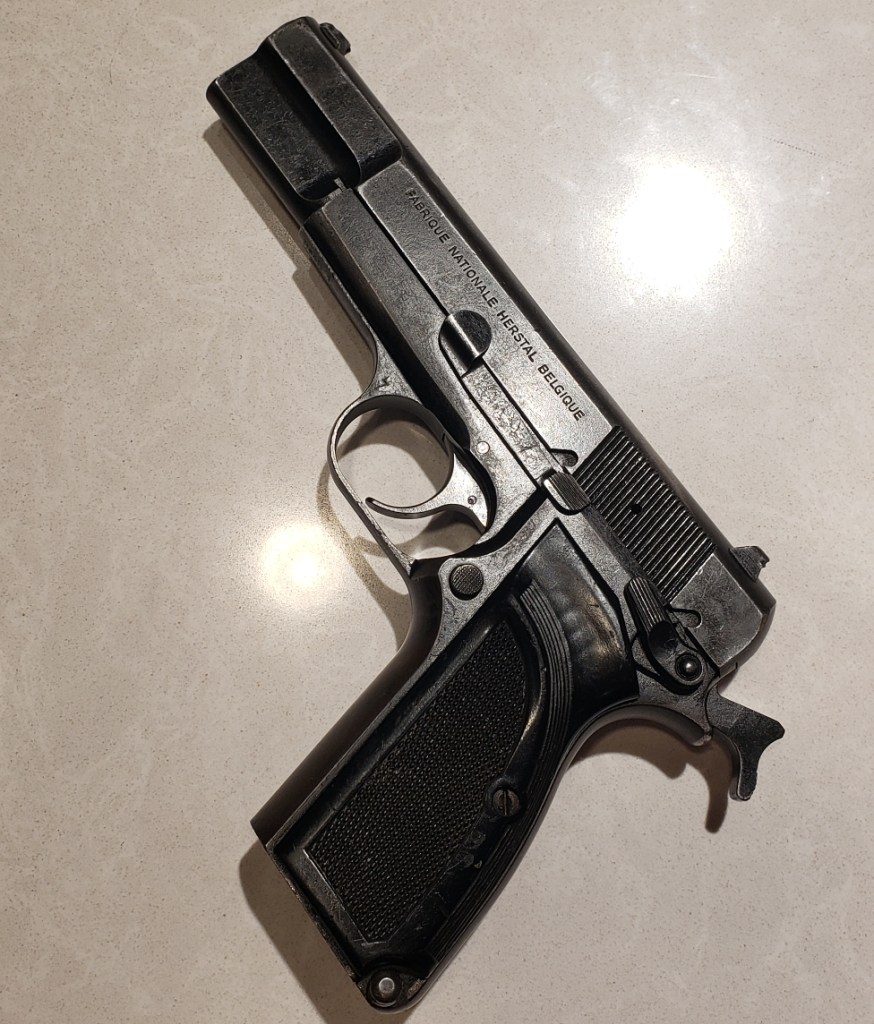
My Hi Power is a Mk III Israeli police contract pistol manufactured in Belgium in 1990. I picked it up from Mach1arsenal.com for about $500. The website listed it as in “Good” condition and I would say that’s accurate. The finish is quite worn in some places and there are a lot of scratches, but the controls are all tight, the barrel still has very clean rifling, and my initial 150 round function test went perfectly. You can see my initial impressions video here, but I’ll cover the main points here. The trigger is trash, easily one of the heaviest single action triggers I’ve ever pulled. The sights have lost their white spots which makes them hard to focus on. The grips are the typical Mk III black plastic thumb rest style, fairly uncomfortable and they add unnecessary width. The overall size is smaller than I would have expected, the grip is similar to that of a Glock 19 as opposed to a 17 or other full size pistol. The weight even with a loaded magazine is very reasonable for a steel framed gun, and the width is really the Hi Power unsung secret. Forward of the trigger guard (the area that I find counts most for comfort while carrying concealed) the Hi Power is essentially the width of a single stack gun. All in all I think this is the perfect foundation for a “modern” Hi Power build.
The Plan
The Goal of “The Hi Power Project” is to upgrade the Hi Power into what could be considered a modern service pistol. My overall plan will consist of three phases of upgrades:
Phase 1: Internal Modifications – I will be installing a BHP enhancement kit from Cylinder & Slide. This will replace most of the springs and some internal parts as well. Since changing springs can affect performance in any pistol, the “official” testing won’t be tracked until after this kit is installed.
Phase 2: External Modifications – These will consist of new grips, new sights, and application of grip tape as necessary. Since these modifications will not affect function, they will be applied and probably changed throughout testing.
Phase 3: Quality of life upgrades – these modifications will be the most expensive and time consuming. They mainly consist of adding an extended beaver tail, as well as front cocking serrations. Due to the cost of adding these modifications, I will wait until after the pistol has passed its initial testing before investing in them.
The Testing
I will be putting the Hi Power through a 1000 round testing protocol before I consider it “certified.” For grading, I will be using the standards from Gun Nuts Media’s old 1911 test videos: The pistol will be scored on a scale of 100, any parts breakage in the first 1000 rounds will deduct 50 points and be considered an automatic failure. Failure to successfully complete the 10-8 performance function test will deduct 15 points, and any failure to complete the cycle of operation will deduct one point each. The ammo used for the testing will be 124 gr FMJs and at least 250 124 gr Federal HSTs, the 10-8 function test will be shot with the HSTs. The 1000 rounds will be shot both at a static range, and in IDPA and USPSA competitions.
Conclusion
Naturally, a lot of the impetus for this project comes from me being a gun hipster. CZs are way too mainstream now and I had to try even harder to get weird. So, stay tuned, there will be a lot of deeply nerdy Hi Power related content both here and on my Youtube channel for some time to come.

 Pro-Gun Millennial