
A few weekends ago I went to the range with the intent of finding out the truth about the difference between red dots & optics.
To be completely honest, I didn’t want to do this at first. Why should I go over ground that’s already been covered? I’m glad that I was talked into it because the results surprised me. Not just in terms of speed, but in accuracy.
The guns we used are my .223 rifle that I took to Desert Brutality, and my friend’s recently finished .300 Blackout build. I chose not to run my silencer during the test. The swing-weights of the two guns weren’t close to comparable with my can attached, so off it came. They were still noticeably different, but I don’t believe that it factored onto our results much.
The optics used were a Holosun red dot (Aimpoint Micro style) and my Athlon 1-6×24 LPVO.
Methods
We decided to do the test at 2 distances. We had a 50 yard bay, so that dictated the longer distance we tested at. There are longer distances available at that range, but I do not feel that there would be much comparison between a red dot and a 6x scope at 100 yards.
Here’s the video of the testing
Looking back we could have obviously done things much different and get better data, but I think what we got is still of interest. Here is the data we got on camera. For the record, I’m Shooter 1.
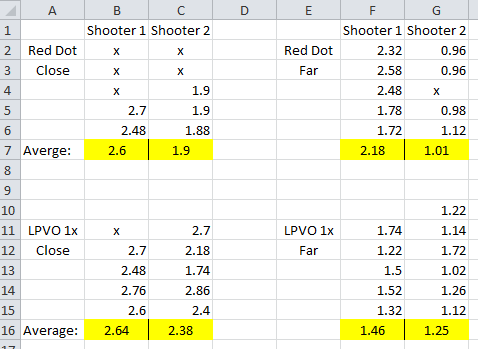
We didn’t show it on camera, but we did check the targets between distances and saw something interesting: the LPVO was not only slower up close, but it was less accurate too.
Conclusion
Red dots are faster. Or, at least the gun that had a red dot on it.
I think it’s because of the lack of precision. With a cross hair, even at 1x, you can see how misaligned you are. Like Benjamin Martin said in The Patriot, “Aim small, miss small.” When a small error in your sight picture registers in your mind as a potential miss, you work to correct it before considering your sight picture ‘good enough‘. When you’re using a 2moa sized dot as your only aiming reference, small misalignments completely disappear, meaning that your brain sees a ‘good enough’ sight picture sooner, and it takes more to screw it up. You shoot sooner, with courser adjustments, and feel better about it after the shot breaks.
An interesting observation that backs up my opinion is that the accuracy with the red dot gun was better than the LPVO gun across both shooters.
Something that is worth mentioning about the data is that Shooter #1 was faster with the LPVO at distance than with the red dot. I assume it was a fluke since the other 3 comparisons have the red dot being faster. This is such a departure from not only the rest of the data we gathered, but from the general consensus of the internet as a whole, that I have to assume that it is a fluke. I’ll definitely look into this in the future and see if there’s anything there I’m missing.
What We Should Have Done Differently
So many things could have been done differently.
First off, filming. The times for the red dot up close are more than half lost because we had technical issues with our timer. We got the one on my phone to work finally, but we had burned so much time and ammo that we didn’t consider going back and re-doing that bit like we should have.
Secondly, we shot different strings of fire at the two different distances, meaning that our data is not nearly as useful as it could be.
Thirdly, we changed the direction of transition halfway through the up-close LPVO testing seemingly at random, and didn’t during the red dot testing.
Fourthly, we didn’t test the guns in the same order each time. It went #1 with dot, #2 with dot, #2 with scope, #1 with dot. Then we changed distances and repeated. At the time it seemed correct. Each shooter owned one of the optics, so we shot owner first, then the other guy shot it, then owner of the other scope, the first guy borrowed it. Upon review, it doesn’t make as much sense.
Lastly, and maybe most importantly, the guns themselves. The optics were on very different guns, further limiting the usefulness of our data. The red dot was mounted on a very lightweight .300BLK pistol with an under-rail can, whereas the 1-6x was on a much heavier 16″ .223 rifle. The weights of the two guns were noticeably different, the swing-weights even more so. I know that this influenced the data were gathered, but I don’t know to what degree.
Future Testing Protocol Evolution
Decide on a course of fire and stick to it throughout the entire test. That way we can see how things do or don’t change within the same gear system as the distance increases.
Don’t change the guns. Either use one gun and swap optics or find 2 guns that are almost identical. Even though it rustled my jimmies a little, having one be a .300 BLK and the other a .223 helped when we looked at the targets, so that is something that I’d be fine with. An ideal testing setup would be identical uppers chambered in different calibers, one with a red dot and the other with a scope. You’d have to be very careful with your mags, though.
The angle of swing changed as we changed distances. Up-close, it was like a 30-45 degree transition, but at the 45 yards line it was closer to 10 degrees. I honestly don’t know if that should be taken into account or not, as it represents a change that would occur in the real world.
Maybe something where you shoot a near (3-5 yard target) then transition 90 degrees to a second target would be interesting. The second target could be up close and then the setup could be replicated on a 100-yard range. If a person doing such a test were to keep track of the times to first shot as well as the splits, it would be very interesting. Hmmm….
What to Take Away From This as a Shooter
There is such a thing as an unnecessary amount of precision. I did not say “too much”, I said unnecessary, as in ‘more than is strictly needed’. At Desert Brutality 2019, I found myself over-confirming my sight picture. I honestly feel like this slowed my performance with my rifle down significantly, and the above results make me believe that I’d have been better off with a red dot. In my dry fire practice (when I actually do it 😞), I have been working on getting over my habit of over-confirming. I just need to decide what kind of sight picture I actually need and pressing the trigger as soon as I get it. I need to tell myself that even though it isn’t perfect, it is good enough. It can be better, but not better enough to justify how much slower it is.
I have said in the past that LPVOs can be as fast as red dots, and I still believe it. I think that it is entirely possible, but it requires the user to be very familiar with the quirks of a 1x scope. The shooter also has to be very good at shooting as soon as an acceptable sight picture is presented. I can tell you from experience that it is not easy, and anyone who can didn’t get there on accident.
This has much wider reaching consequences than just shooting. With anything in life, when I’m presented with small amounts of info I can make decisions rapidly and decisively. When I’m given a lot of info, I try to use all of it to make a decision. This leads to what I’ve heard called “paralysis by analysis”. When I have lots of options I need to work on figuring out what information I actually need to know, getting only that info, and disregarding everything that doesn’t matter. Find a solution that’s good enough, find it for a decent price (if applicable), and stop worrying about the little, tiny, insignificant minutia. A 90% solution now is better than a 100% solution in the future.
Now that I’m back, here’s where I’ll be:
See you next Friday. -S_S
 Pro-Gun Millennial
Your last paragraph was superb. Live and learn!
LikeLiked by 1 person
Thanks! As Miyamoto Musashi said, “If you know the way broadly you will see it in everything.”
LikeLiked by 1 person
Good post.
A good plan executed vigorously right now is better than waiting for a perfect plan executed next week. I think too many people try and wait for perfect information or the perfect piece of gear before getting out there and doing it.
I feel the compulsion to rant about it, now.
LikeLiked by 1 person
Rant away, just link back here when you do 😁
LikeLike
Interesting… I’ve used both in classes (on the same gun), and I have yet to reach a clear consensus for myself and my AO. Perhaps I should go to the range with a rifle and a couple of optics on QD mounts. I think some interesting data could be obtained with simple “up” drills on a timer at various ranges, although I also like your inclusion of a target transition. I suspect that the rifle itself does heavily play into this data set… the handling characteristics of my 10.5″ SBR are discernibly different than my 14.5″ gun, for instance. As you point out, throw a suppressor on the end of the barrel, and that dynamic changes even more. I know that KD4 has said that he’s not any slower with the LPVO, but very few of us have his experience and raw talent. There may also be some corollaries here with the debate and data regarding irons vs. RDS on pistols. Perfect practice makes perfect. And perfection is the enemy of good enough.
LikeLiked by 1 person
I do think that experience plays into this a lot. The more experienced someone is, the less their equipment is going to hold them back.
LikeLike